Postingan

Menampilkan postingan dengan label teknik insos

Translate

Prejudice Reduction:

Jurnal: Paluck, E. L., & Green, D. P. (2009). Prejudice reduction: What works? A review and assessment of research and practice.   Annual review of psychology , 60 , 339-367. Note: Ini hanya sebuah catatan pribadi, mohon rujuk sumber asli Prejudice Reduction: What Works? A Review and Assessment of Research and Practice Elizabeth Levy Paluck 1 Donald P. Green 2 1 Harvard Academy for International and Area Studies, Weather head Center for International Affairs, Harvard University, Cambridge, Massachusetts 02138; email: epaluck@wcfia.harvard.edu 2 Institution for Social and Policy Studies, Yale University, New Haven, Connecticut 06520-8209; email: donald.green@yale.edu Key Words: field experiments, evaluation, stereotype reduction, cooperative learning, contact hypothesis, peace education, media and reading interventions, diversity training, cultural competence, multicultural education, anti-bias education, sensitivity training, cognitive training ...

Persuasive Normative Messages: The Influence of Injunctive and

Gambar
Persuasive Normative Messages: The Influence of Injunctive and Personal Norms on Using Free Plastic Bags de Groot, J. I., Abrahamse, W., & Jones, K. (2013). Persuasive normative messages: The influence of injunctive and personal norms on using free plastic bags.   Sustainability ,   5 (5), 1829-1844. Please reference to source, this paper for note only Abstract: In this exploratory field-study, we examined how normative messages ( i.e. , activating an injunctive norm, personal norm, or both) could encourage shoppers to use fewer free plastic bags for their shopping in addition to the supermarket‘s standard environmental message aimed at reducing plastic bags. In a one-way subjects-design ( N = 200) at a local supermarket, we showed that shoppers used significantly fewer free plastic bags in the injunctive, personal and combined normative message condition than in the condition where only an environmental message was present. The combined normative...

The Constructive, Destructive, and Reconstructive Power of Social Norms

Gambar
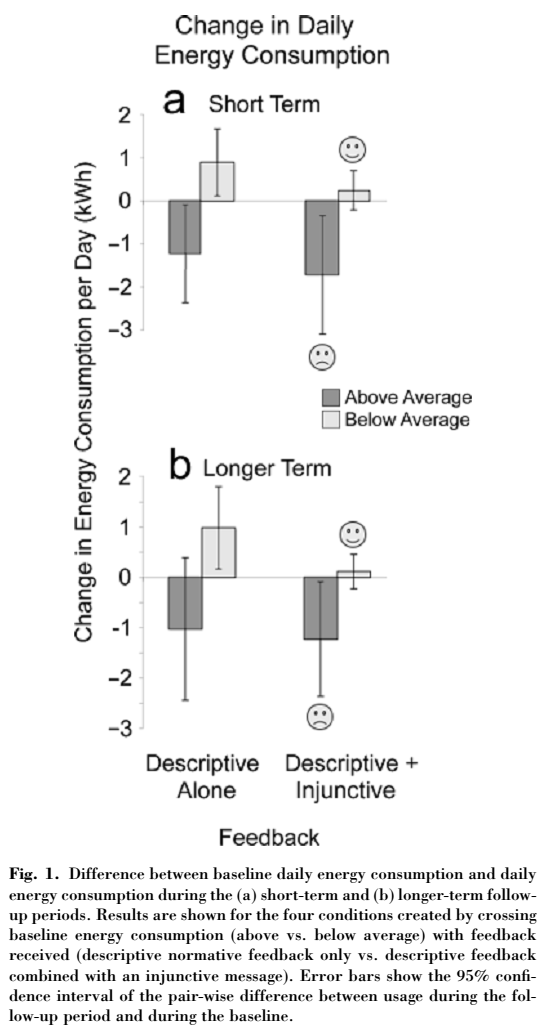
The Constructive, Destructive, and Reconstructive Power of Social Norms Schultz, P. W., Nolan, J. M., Cialdini, R. B., Goldstein, N. J., & Griskevicius, V. (2007). The constructive, destructive, and reconstructive power of social norms.   Psychological science ,   18 (5), 429-434. Please reference to source, It’s note only ABSTRACT—Despite a long tradition of effectiveness in laboratory tests, normative messages have had mixed success in changing behavior in field contexts, with some studies showing boomerang effects. To test a theoretical account of this inconsistency, we conducted a field experiment in which normative messages were used to promote household energy conservation. As predicted, a descriptive normative message detailing average neighborhood usage produced either desirable energy savings or the undesirable boomerang effect , depending on whether households were already consuming at a low or high rate. Also as predicted, ad...
Ini hanya catatan pribadi. sumber:                                                            http://www.google.com/url?sa=t&rct=j&q=&esrc=s&source=web&cd=1&cad=rja&uact=8&ved=0CCIQFjAA&url=http%3A%2F%2Fwww.st-andrews.ac.uk%2Fitsold%2Fpapers%2Fpublic%2Fmiscellaneous%2Fprintingproblems%2Fpower-webct.doc&ei=NvBZVKzGJIONuAT72IG4DQ&usg=AFQjCNE3l9KhJDpHyJsYF0tH4O0YKP5MTA&sig2=JGjPmHkRzFF9Ty5LmUVsjA&bvm=bv.78677474,d.c2E The intergroup dynamics of collective empowerment: Substantiating the social identity model of crowd behaviour John Drury University of Sussex & Steve Reicher University of St. Andrews   Corres...