Postingan

Menampilkan postingan dengan label social norms

Translate

An Overview of the Social Norms Approach

An Overview of the Social Norms Approach Berkowitz, A. D. (2005). An overview of the social norms approach.   Changing the culture of college drinking: A socially situated health communication campaign , 193-214. Please reference to source, this paper for note only Introduction   “Social Norms” is a theory and evidence-based approach to addressing health issues that has gained increasing attention. A social norms intervention have been successful in reducing alcohol and tobacco use in college and high school populations, and has promise as an intervention to address violence and social justice issues. As a result of these successes, practitioners in the field of social norms have received national recognition for their work and social norms programs have received a number of best practice awards from Federal agencies. Currently social norms interventions are being funded by the United States Department of Education, the Department of Justice, and the Center...
The Effects of Recognition and Group Need on Volunteerism

Jurnal: The Effects of Recognition and Group Need on Volunteerism - A Social Norm Perspective ROBERT J. FISHER DAVID ACKERMAN Fisher ,   R. J. ,   & Ackerman ,   D. (1998). The effects of recognition and group need on volunteerism: A social norm perspective.   Journal of Consumer Research , 25 (3) ,   262-275. Ini hanya sebuah catatan untuk pribadi, silahkan merujuk sumeber aslinya. Note only, please reference to source The significance of volunteering for both individuals and society has lead to numerous studies on this behavior across the social sciences. However ,   virtually no prior research has evaluated how and to what extent organizations can effectively encourage individuals to contribute time to a worthy cause. The present research uses a social norm perspective to examine the conditions under which promotional appeals based on group need and promises of recognition affect volunteerism. The perspective suggests...

The Social Norms Approach:Theory, Research, and Annotated Bibliography

The Social Norms Approach:Theory, Research, and Annotated Bibliography Berkowitz, A. D. (2004). The social norms approach: Theory, research and annotated bibliography.   Higher Education Center for Alcohol and Other Drug Abuse and Violence Prevention. US Department of Education . Please reference to source, this paper for note only  from: http://www.alanberkowitz.com/articles/social_norms.pdf     Preface – The State of Social Norms Prevention approaches that provide normative feedback are growing by leaps and bounds in popularity and evidence is mounting that these programs can be effective when correctly implemented. As a result there is a need for a comprehensive review of the social norms literature to provide practitioners with an overview of important research, to summarize the evaluation literature regarding its effectiveness, and to address questions and concerns. It is my hope that this review will serve this purpose. I am ...

INVOKING SOCIAL NORMS-Ind

Jurnal: INVOKING SOCIAL NORMS A SOCIAL PSYCHOLOGY PERSPECTIVE ON IMPROVING HOTEL’S LINEN-REUSE PROGRAM Goldstein, N. J., Griskevicius, V., & Cialdini, R. B. (2007). Invoking Social Norms A Social Psychology Perspective on Improving Hotels' Linen-Reuse Programs.   Cornell Hotel and Restaurant Administration Quarterly ,   48 (2), 145-150. Goldstein, N. J., Griskevicius, V., & Cialdini, R. B. (2007). Invoking Social Norms A Social Psychology Perspective on Improving Hotels' Linen-Reuse Programs.   Cornell Hospitality Quarterly, 48 /145. DOI: 10.1177/0010880407299542 Note: Ini hanya sebuah catatan pribadi, mohon rujuk ke sumber aslinya —   Penyediaan handuk untuk tamu hotel biasanya diganti ulang setiap hari —   Laundry mahal —   Memasukkan konsep “environmental issues” ke dalam praktik bisnis —   Beberapa hotel menyediakan kartu di kamar mandi hotel, berisi himbauan agar tamu menggunakan ulang handuk hotel Meminjam N...

The Focus Theory of Normative Conduct: Application to Pro-environmental

Jurnal: The Focus Theory of Normative Conduct: Application to Pro-environmental  Grocery Shopping Behaviors Ellen Weir A thesis Submitted in partial fulfillment of the Requirements for the degree of  Master of Science University of Washington 2012 Committee: Stanley Asah, Thesis Advisor Dale Blahna Sergey Rabotyagov Program Authorized to Offer Degree: Environmental and Forest Sciences Note only, please reference to source From: https://digital.lib.washington.edu/researchworks/bitstream/handle/1773/20563/Weir_washington_0250O_10395.pdf?sequence=1&isAllowed=y http://hdl.handle.net/1773/20563 (1 Okt 2014) University of Washington

Persuasion, Frames and Norm Construction

Jurnal: Payne, R. A. (2001). Persuasion, frames and norm construction.   European Journal of International Relations ,   7 (1), 37-61. Persuasion, Frames and Norm Construction RODGER A. PAYNE University of Louisville, USA European Journal of International Relations Copyright © 2001 SAGE Publications and ECPR, Vol. 7(1): 37-61 (1354-0661 [200103] 7:1; 37-61; 016345) Note only, please reference to source From: http://www.communicationcache.com/uploads/1/0/8/8/10887248/persuasion_and_norm_construction.pdf  (1 Okt 2014) Constructivist theorists view norms as shared understandings that reflect ‘legitimate social purpose’. Because the focus is on the ideational building blocks that undergird a community’s shared understandings, rather than material forces, persuasive communication is considered fundamentally important to norm-building. In practice, this means that frames are crafted by norm entrepreneurs so as to resonate with audiences. However, th...

The Transsituational Influence of Social Norms

Gambar
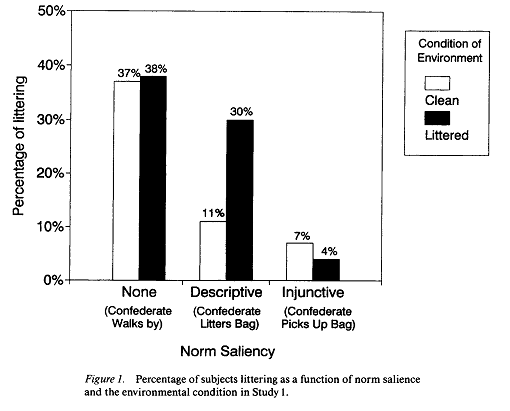
Jurnal: Tolong rujuk ke sumber asli The Transsituational Influence of Social Norms Raymond R. Reno, Robert B. Cialdini, and Carl A. Kallgren Journal of Personality and Social Psychology, 1993, Vol.64, No. 1,104-112 Copyright 1993 by the American Psychological Association Inc 0022-3514/93/S3.00 Three studies examined the behavioral implications of a conceptual distinction between 2 types of social norms: descriptive norms, which specify what is typically done in a given setting, and injunctive norms, which specify what is typically approved in society. Using the social norm against littering, injunctive norm salience procedures were more robust in their behavioral impact across situations than were descriptive norm salience procedures. Focusing Ss on the injunctive norm suppressed littering regardless of whether the environment was clean or littered (Study 1) and regardless of whether the environment in which Ss could litter was the same as or different from that in w...

Using Social Norms to Motivate Environmental Conservation

A Room with a Viewpoint: Using Social Norms to Motivate Environmental Conservation in Hotels Noah J. Goldstein Robert B. Cialdini Vladas Griskevicius* Published by: The University of Chicago Press Article DOI: 10.1086/586910 Stable URL: http://www.jstor.org/stable/10.1086/586910 Elektronik diterbitkan 3 Maret 2008 di unduh: http://www.jstor.org/stable/10.1086/586910#mobileBookmark 21 sept 2014 aslinya ada di   http://www.jstor.org/stable/10.1086/586910 Goldstein, N. J., Cialdini, R. B., & Griskevicius, V. (2008). A room with a viewpoint: Using social norms to motivate environmental conservation in hotels.Journal of consumer Research, 35(3), 472-482. Two field experiments examined the effectiveness of signs requesting hotel guests’ participation in an environmental conservation program. Appeals employing descriptive norms (e.g., “the majority of guests reuse their towels”) proved superior to a traditional appeal widely used by hotels that focused solely on envir...

Changing the habit by changing the context

Gambar
Perilaku Berkelanjutan: Mengubah kebiasaan dengan mengubah konteks copy paste from: http://blog.sustainability.colostate.edu/?q=node/59 23 Sept 2014  Sustainable behavior: Changing the habit by changing the context Ditulis oleh  Liesel Hans  ,    SoGES 2013-2014 Sustainability Leadership Fellow , and PhD Candidate in the  Department of Economics Habits make life easier in a hectic, fast-paced world. It’s hard to fight routine and convenience. There are actions taken everyday that we probably would acknowledge as something we could, to our own benefit, do differently (candy dish, anyone?). We unfortunately aren’t the perfectly rational or consistent decision-makers suggested by traditional economic theory.

Always Be normal

Always Be normal copas from:  http://www.thehumaneleague.com/changeofheart/e_normal.htm Kami suka berpikir kita independen dan bahwa kita membuat pilihan berdasarkan apa yang ingin kita lakukan, bukan apa yang orang lain lakukan. Namun penelitian tentang sosial norma-informasi tentang apa yang kebanyakan orang lain lakukan-menyarankan kita dipengaruhi oleh pendapat mayoritas lebih dari yang kita pikirkan. Menjalankan norma-norma sosial dapat membantu aktivis berhasil mengubah sikap dan perilaku. Tadi kita membahas bagaimana memanggil norma-norma sosial lebih berhasil dalam mendapatkan pemilik rumah untuk menghemat energi daripada menarik bagi penghematan keuangan, manfaat masyarakat atau perlindungan lingkungan.  Dalam studi lain, peneliti persuasi terkenal Robert Cialdini dan rekan-rekannya bekerja dengan sebuah hotel untuk membuat perubahan pada tanda-tanda kamar mendorong penggunaan kembali handuk.  Sebelumnya tanda-tanda telah meminta para tamu un...

A social influence model of consumer participation in network- and small-group-based virtual communities

Gambar
A social influence model of consumer participation in network- and small-group-based virtual communities Utpal M. Dholakia a , * , Richard P. Bagozzi a , Lisa Klein Pearo b a Rice University, Jesse H. Jones Graduate School of Management, 6100 Main Street, 314 Herring Hall-MS 531, Houston, TX 77005, USA b Cornell University, Cornell School of Hotel Administration, Ithaca, NY 14853, USA Received 8 May 2003; received in revised form 1 September 2003; accepted 5 December 2003 Abstract We investigate two key group-level determinants of virtual community participation—group norms and social identity—and consider their motivational antecedents and mediators. We also introduce a marketing-relevant typology to conceptualize virtual communities, based on the distinction betweennetwork-based and small-group-based virtual communities. Our survey-based study, which was conducted across a broad range of virtual communities, supports the proposed model and finds furth...

Persuasive Trash Cans Activation of Littering Norm by Design

Gambar
Persuasive Trash Cans Activation of Littering Norm by Design  Yvonne A. W. de Kort L. Teddy McCalley Cees J. H. Midden Eindhoven University of Technology Please reference to source, this paper for note only Two studies tested littering norm activation by trash can design. The first was a scenario study using a 4 (norm type: social injunctive vs. social descriptive vs. personal vs. control) ×2 (activation type: explicit vs. implicit activation) between-group design, with judgments of a litterer as the dependent variable. Explicit norm activation was more effective than implicit activation. A field study subsequently tested the effect of personal norm activation on actual littering behavior, following a 2 (explicit activation: no vs. yes) ×2 (Implicit activation: no vs. yes) between-group design. Here, both explicit activation through a verbal prompt and implicit activation through design had significant effects, reducing the amount of litter by 50%. A po...

Descriptive and Injunctive Norms in College Drinking

Descriptive and Injunctive Norms in College Drinking: A Meta-Analytic Integration Borsari, B., & Carey, K. B. (2003). Descriptive and Injunctive Norms in College Drinking: A Meta-Analytic Integration.   Journal of Studies on Alcohol ,   64 (3), 331–341. Please reference to source, this paper for note only  from: Copy from: http://www.ncbi.nlm.nih.gov/pmc/articles/PMC2431131/ Go to: Abstract Objective Many college students overestimate both the drinking behaviors (descriptive norms) and the approval of drinking (injunctive norms) of their peers. As a result, consistent self-other discrepancies (SODs) have been observed, in which self-perceptions of drinking behaviors and approval of drinking are usually lower than comparable judgments of others. These self-other discrepancies form the foundation of the currently popular “social norms approach” to alcohol abuse prevention, which conveys to students the actual campus norms regarding drink...

Crafting Normative Messages to Protect the Environment

Gambar
Jurnal: Crafting Normative Messages to Protect the Environment Cialdini, R. B. (2003). Crafting normative messages to protect the environment. Current directions in psychological science ,   12 (4), 105-109. Note: Harap merujuk ke sumber aslinya (30 Sept 2014) It is widely recognized that communications that activate social norms can be effective in producing societally beneficial conduct. Not so well recognized are the circumstances under which normative information can backfire to produce the opposite of what a communicator intends. There is an understandable, but misguided, tendency to try to mobilize action against a problem by depicting it as regrettably frequent. Information campaigns emphasize that alcohol and drug use is intolerably high, that adolescent suicide rates are alarming, and most relevant to this article that rampant polluters are spoiling the environment. Although these claims may be both true and well intentioned, the campaigns creators have mi...

A focus theory of normative conduct: Recycling

Gambar
A focus theory of normative conduct: Recycling the concept of norms to reduce littering in public places. Cialdini, Robert B. ;   Reno, Raymond R. ;   Kallgren, Carl A. .   Journal of Personality and Social Psychology ,58.6 . (Jun 1990): 1015-1026. This article is personal Note only, please reference to source Abstrak Past research has generated mixed support among social scientists for the utility of social norms in accounting for human behavior. We argue that norms do have a substantial impact on human action; however, the impact can only be properly recognized when researchers (a) separate 2 types of norms that at times act antagonistically in a situation—injunctive norms (what most others approve or disapprove) and descriptive norms (what most others do)—and (b) focus Ss' attention principally on the type of norm being studied. In 5 natural settings, focusing Ss on either the descriptive norms or the injunctive norms regarding littering caused the Ss' litte...

Persuasive Normative Messages: The Influence of Injunctive and

Gambar
Persuasive Normative Messages: The Influence of Injunctive and Personal Norms on Using Free Plastic Bags de Groot, J. I., Abrahamse, W., & Jones, K. (2013). Persuasive normative messages: The influence of injunctive and personal norms on using free plastic bags.   Sustainability ,   5 (5), 1829-1844. Please reference to source, this paper for note only Abstract: In this exploratory field-study, we examined how normative messages ( i.e. , activating an injunctive norm, personal norm, or both) could encourage shoppers to use fewer free plastic bags for their shopping in addition to the supermarket‘s standard environmental message aimed at reducing plastic bags. In a one-way subjects-design ( N = 200) at a local supermarket, we showed that shoppers used significantly fewer free plastic bags in the injunctive, personal and combined normative message condition than in the condition where only an environmental message was present. The combined normative...

The Constructive, Destructive, and Reconstructive Power of Social Norms

Gambar
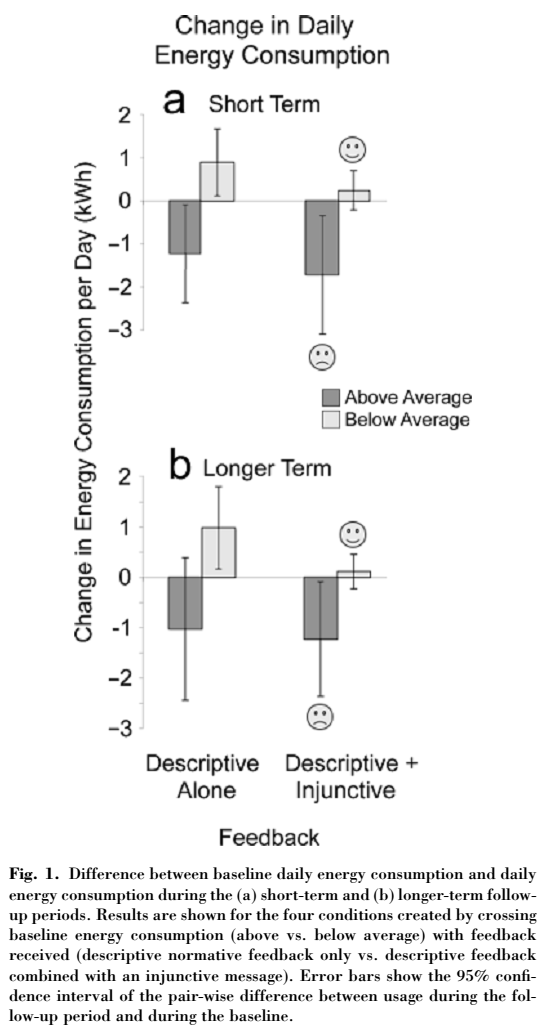
The Constructive, Destructive, and Reconstructive Power of Social Norms Schultz, P. W., Nolan, J. M., Cialdini, R. B., Goldstein, N. J., & Griskevicius, V. (2007). The constructive, destructive, and reconstructive power of social norms.   Psychological science ,   18 (5), 429-434. Please reference to source, It’s note only ABSTRACT—Despite a long tradition of effectiveness in laboratory tests, normative messages have had mixed success in changing behavior in field contexts, with some studies showing boomerang effects. To test a theoretical account of this inconsistency, we conducted a field experiment in which normative messages were used to promote household energy conservation. As predicted, a descriptive normative message detailing average neighborhood usage produced either desirable energy savings or the undesirable boomerang effect , depending on whether households were already consuming at a low or high rate. Also as predicted, ad...
SOCIAL INFLUENCE: Compliance and Conformity Cialdini, R. B., & Goldstein, N. J. (2004). Social influence : Compliance and conformity.   Annual Review of Psychology,55 , 591-621. Retrieved from http://search.proquest.com/docview/205845016?accountid=1724 ... Cialdini, R. B., & Goldstein, N. J. (2004). Social influence: Compliance and conformity.   Annu. Rev. Psychol. ,   55 , 591-621. Please reference to source, It’s note only ABSTRACT This review covers recent developments in the   social influence   literature, focusing primarily on compliance and conformity research published between 1997 and 2002. The principles and processes underlying a target's susceptibility to outside   influences   are considered in light of three goals fundamental to rewarding human functioning. Specifically, targets are motivated to form accurate perceptions of reality and react accordingly, to develop and preserve meaningful   socia...

On being loud and proud: Non-conformity and counter-conformity to group norms

  On being loud and proud: Non-conformity and counter-conformity to group norms Matthew J. Hornsey, Louise Majkut, Deborah J. Terry and Blake M. McKimmie Hornsey, M. J., Majkut, L., Terry, D. J., & McKimmie, B. M. (2003). On being loud and proud: Non ‐ conformity and counter ‐ conformity to group norms.  British Journal of Social Psychology ,  42 (3), 319-335.     . Please reference to source, its note only http://search.proquest.com/docview/219172185/fulltext/635F5C24CA2C4CA3PQ/10?accountid=172  http://www.researchgate.net/publication/231583261_On_being_loud_and_proud_non-conformity_and_counter-conformity_to_group_norms/links/09e4150ee00c019114000000 http://eprints.qut.edu.au/3804/1/3804_1.pdf Abstrak Most experiments on conformity have been conducted in relation to judgments of physical reality; surprisingly few papers have experimentally examined the influence of group norms on social issues with a moral component. ...

The theory of planned behaviour:

Gambar
The theory of planned behaviour: Self-identity, social identity and group norms Terry, D. J., Hogg, M. A., & White, K. M. (1999). The theory of planned behaviour: Self-identity, social identity and group norms.   The British Journal of Social Psychology,   38 , 225-44.  Only note please reference to source: http://search.proquest.com/      et.al Abstravc The aim of the present study was to examine further the role that self- identity  plays in the theory of planned behaviour and, more specifically, to: (1) examine the combined effects of self- identity  and  social identity constructs on intention and behaviour, and (2) examine the effects of self- identity  as a function of past experience of performing the behaviour. The study was concerned with the prediction of intention to engage in household recycling and reported recycling behaviour. A sample of 143 community residents participated in the study. It was prospecti...