Postingan

Menampilkan postingan dengan label Buku

Translate

Understanding Community

6 Understanding Community   Opening Exercise What Is a Community? Types of Communities Levels of Communities Who Defines Communities? Sense of Community Four Elements of Sense of Community Questions and Issues for Defining Sense of Community Concepts Related to Sense of Community The Importance of Community Social Capital The Complex Realities of Communities Multiple Communities in a Person’s Life Conflict and Change within a Community Are Communities Declining? Building Communities The Physical and Natural Environments Spirituality, Religion, and Communities Online Communities Conclusion Chapter Summary Recommended Readings OPENING EXERCISE Take a look at the following quotes. What do you think these people are talking about? Are they all talking about the same thing? Try to make some guesses about who these people are and what kinds of settings they are ref...

Ecology, Prevention and Promotion

Gambar
Nelson, G., & Prilleltensky, I. (2005). Community psychology: In pursuit of liberation and well-being . Palgrave Macmillan 4 Ecology, Prevention and Promotion Warm-up Exercise 1. Reflecting on your childhood, think of some risk factors or stressful situations that threatened your sense of wellbeing. 2. What were some of the resources or protective factors (personal qualities, relationships, situations) that helped you deal with those stressful situations? In this chapter, you will learn the definition, rationale, value-base, action implications and limitations of two of the key principles on which community psychology (CP) has been built: ■ the ecological metaphor ■ prevention and promotion. We elaborate on each of these concepts that we briefly introduced in Chapter 2. Macro-system (for example social norms, policies) Figure 4.1   Nested ecological levels of analysis Source: Prilleltensky, Nelson & Peirson (2001a) 

Values for Community Psychology-Nelson

Gambar
Referat Buku: Psikologi masyarakat Menghubungkan Individu dan Komunitas EDISI KETIGA Geoffrey Nelson dan Isaac Prilleltensky Bagian II Nilai, Prinsip dan Konseptual Alat Tujuan dari bagian kedua dari buku ini adalah untuk menjawab pertanyaan: Mengapa CP ingin mempromosikan pembebasan dan kesejahteraan dan prinsip-prinsip apa dan alat-alat konseptual harus mengarahkan pekerjaan CP? Dalam masing-masing empat bab dalam bagian ini, kita menguraikan prinsip-prinsip kunci dan alat-alat konseptual dan menunjukkan bagaimana mereka dapat menangani masalah-masalah sosial yang penting dan masalah.

Keragaman Nilai

Dari Buku Joining Together-Johnson&Johnson Basic Concepts to Be Covered in This Chapter In this chapter a number of concepts are defined and discussed. The major ones are in the following list. Divide into pairs. Each pair is to (  1)  define each concept, noting the page on which it is defined and discussed, and (2) ensure that both members of the pair understand the meaning of each concept. Then join with another pair to make a group of four. Compare the answers of the two pairs. If there is disagreement, look up the concept in the chapter and clarify it until all members agree on and understand the definition. Concepts 1. Ability and skill diversity 2. Demographic diversity 3. Stereotype 4. Prejudice 5. Ethnocentrism 6. Discrimination 7. Blaming the victim 8. Causal attribution 9. Culture clash 10. Personal identity 11. Personal diversity ========= ============= INTRODUCTION In the story  Beauty and  the Beast,  Beauty, to save ...

Understanding Individuals Within Environments

Dalton, JH Kloos, B., Hill, J., Thomas, E., Wandersman, A., & Elias, M. (2007). psikologi Community: Menghubungkan individu dan masyarakat . Cengage Learning . BAB 5 5 Memahami Individu Dalam Lingkungan KESIMPULAN: PROMISE DAN TANTANGAN OF MENGUBAH LINGKUNGAN Zona The Harlem Anak dan Lodge contoh Fair-cuaca menunjukkan potensi menggunakan perspektif ekologi untuk mempromosikan kesejahteraan individu dan keluarga. Lingkungan dapat menjadi sumber masalah bagi individu dan juga menawarkan sumber daya untuk bernegosiasi tantangan dalam kehidupan individu dan masyarakat. Rudolf Moos (2002, 2003) menghabiskan karir mengembangkan kerangka kerja dan langkah-langkah nya untuk memahami peran bahwa faktor lingkungan dapat bermain di kesejahteraan. Dia mengidentifikasi empat pertanyaan abadi tentang hubungan individu dan konteks ekologi yang merangkum kompleksitas hubungan ini. Pertanyaan-pertanyaan ini pertimbangan membantu bagi siapa saja yang tertarik dalam perubahan kondisi...

COLONIZATION & RACISM COMMUNITY PSYCHOLOGY

Geoffrey Nelson and Isaac Prilleltensky COLONIZATION & RACISM COMMUNITY PSYCHOLOGY Chapter 16 The goals of this chapter are to: ■ show how psychology has developed within a colonial, racist context ■ introduce decolonization work in two societies shaped by colonization ■ communicate the urgency of self-determination and social justice for indigenous peoples   ■ suggest ways in which psychologists can support decolonization, including practical examples and student exercises. Introduction In this chapter an Australian Aboriginal woman, a Maori and a pakeha (white) New Zealander draw on their life experiences and work as psychologists to discuss colonization, racism and decolonization. Concepts essential to the pursuit of well-being and liberation for communities affected by colonization, such as self-determination and social justice, are explained and discussed. Case stories describe practical ways in which decolonization is being pursued in Aus...

Community and Power

Gambar
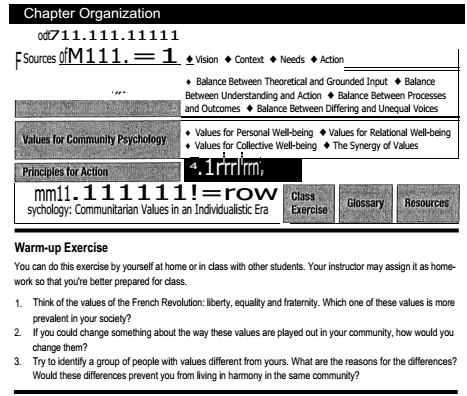
Nelson, G. & Prilleltensky, J (2005). Community Psychology In Pursuit Of Liberation And Well-Being . New York: Palgrave Macmillan. p.93-114 5 Community and Power Chapter Organization

Managing Conflicts of Interest

Gambar
Johnson, David W., 1940-  Joining together : group theory and group skills / David W. Johnson, Frank  P. Johnson.— 10th ed.  9 Managing Conflicts of Interest 366 Basic Concepts to Be Covered in This Chapter 367 Conflict-Positive Groups 367 Nature of Conflicts of Interest 368 Conflicts Can Be Destructive or Constructive 369 Conflict and Aggression 370 Conflict Management Strategies: What Are You Like?  373 Controlling the Occurrence of Conflicts 377 The Nature of Negotiations 378 Two Types of Negotiating 385 The Integrative Negotiating Procedure 390 Defining the Conflict as a Mutual Problem 393 Try, Try Again 407 Negotiating in Good Faith 410 Refusal Skills: This Issue Is Non-Negotiable 411 Intergroup Conflict 419 Third-Party Mediation 435 Summary 436

THE INTEGRATIVE NEGOTIATING PROCEDURE

Johnson, David W., 1940-  Joining together : group theory and group skills / David W. Johnson, Frank  P. Johnson.— 10th ed.  THE INTEGRATIVE NEGOTIATING PROCEDURE Step One: Describe What You Want (Your Interests) In describing what you want, you assert your wants and listen carefully to the other person's wants. Describing your wants and goals includes describing (not evaluating) the other person's actions and defining the conflict as a mutual problem and in as small and specific a way as possible. Describing What You Want.  Negotiating begins when you describe what you want. Everyone has a perfect right to express what his or her wants, needs, and goals are (Alberti & Emmons, 1978 ;  Table 9.4). You have a perfect right to assert what you want, and the other person has a perfect right to assert what he or she wants. Being  assertive  is stating your wants, needs, and goals directly to another person in an honest and appropriate ...

INTERGROUP CONFLICT-Joning

Johnson, David W., 1940-  Joining together : group theory and group skills / David W. Johnson, Frank  P. Johnson.— 10th ed.  p. cm.  Includes bibliographical references and index.  ISBN-13: 978-0-205-57863-4  ISBN-10: 0-205-57863-2  1. Social groups. 2. Leadership. 3. Group relations training. I.  Johnson, Frank P. (Frank Pierce), 1935- II. Title.  HM716.J64 2009  302—dc22 ============= INTERGROUP CONFLICT  The first half of this chapter discussed the nature of conflicts among individuals within groups and ways to manage them. The groups to which we belong interact with other groups and sometimes conflicts arise. Knowing how to manage conflicts among groups is equally as important as knowing how to deal with conflicts among individuals.  About 1260 sac., one of the great intergroup conflicts in history occurred between the powerful Greek king of Sparta (Menelaus) and his allies and Paris from the ...

Education Intervention (5)- Summary

SUMMARY AND CONCLUSION: WHAT CAN EDUCATION ACCOMPLISH? We have discussed educational interventions aimed at promoting fairly specific pro-environmental attitudes and beliefs among individuals and overcoming inter­ nal barriers, such as lack of knowledge or commit­ ment, that keep them from acting on those attitudes. Education can make a difference in people's behavior, but there are serious limits to what it can accomplish. The chapter supports the following general conclu­ sions: In the short term, educational approach • work only when the main barriers to action ar interna o the individual. As we have seen, education live mainly with relatively simple, low-cost behaviors, such as depositing cans in curbside recycling bins or altering home thermostat settings. Such actions help, but they typically have smaller effects on the environ­ mental problems they are meant to lessen than more permanent actions such as purchasing an energy-effi­ cient vehicle or appliance (see Chapt...

Education Intervention (4)- TIGHTENING THE LINKS

Gambar
TIGHTENING THE LINKS FROM ATTITUDES TO BEHAVIOR Table 4-2 shows that even in the presence of favorable attitudes, knowledge does not lead directly or auto matically to pro-environmental behavior. People do not always do what they are predisposed to do, even if they know how and there are no external barriers. An example is people who save recyclables for a long period but never "get around to" taking them to the recycling center. Another example: Homeowners who want to use the city's collection service for com­ postable yard wastes but forget to put the wastes near the curb on the proper day. Or shoppers who prefer environmentally friendly products but feel too preoc­ cupied with getting through their shopping lists to fully attend to their environmental concerns. We are referring here to level 2 of the table—"attention, com­ mitment, etc." In order for people to express their pro-environmental attitudes in actual behavior, they must pay attention to enviro...

Education Intervention (3)- EFFORTS TO CHANGE BEHAVIOR

Gambar
EFFORTS TO CHANGE BEHAVIOR WITH INFORMATION Lack of information can be a serious internal barrier to action because it is not always obvious to an indi­ vidual how to act effectively on his or her attitudes. This is especially the case for environmental protec­ tion, because the connections between behavior and its environmental effects can be impossible to discern from personal experience. Only expert analysts can tell which behaviors have the greatest effect on global warming or the extinction of species in distant tropi­ cal forests, so nonexperts cannot be expected to know what to do without some assistance. Even with a relatively simple problem, such as reducing energy use in the home, many people do not know which conservation actions are most effective, as we show in Chapter 10. How much can be done to protect the environment by informing consumers? The best evidence comes from careful studies of deliberate interventions— studies that compare the behavior of people who ha...

EDUCATIONAL INTERVENTIONS (2): Box 4-1

Box 4-1 _____________________________________________________ Attitudes versus Barriers to Action:- Energy Conservation in Massachusetts, 1980 In the summer of 1980, a period of serious national concern about energy conservation and rapidly rising energy prices, one of the authors and his colleagues conducted a statewide survey of energy conservation activities in Massachusetts (Black, Stern, and Elworth, 1985). We surveyed a random sample of the house­holds served by the state's five major electric utility companies, and received responses from 478 house­ holds across the state. We tried to explain why house­ holds differed in what they had done to conserve energy and particularly, to see how much internal psychological factors, such as attitudes and beliefs, mattered in comparison with external factors such as income, home ownership, household size, and the like. We examined four classes of energy-saving ac­ tivities: major investments (such as insulating walls and...

CHAPTER 3- Gardner

Gambar
CHAPTER 3____________ RELIGIOUS AND MORAL APPROACHES: CHANGING VALUES, BELIEFS, AND WORLDVIEWS I. Chapter Prologue II. Introduction III. Do Values, Morals, Beliefs, and Religious Teachings and Practices Affect How Individuals and Cultures Treat Their Environment? A.     Survey-Research in a Single Country (the United States) B.     Historical and Intercultural Evidence IV. Proenvironmental Religious/Moral Movements—Current Developments and Possible Future Trends A.   Ecotheology B.   Thomas Berry's Work C.   The Deep Ecology Movement D.   Ecofeminism

CHAPTER 3- Gardner

Gambar
CHAPTER 3____________ RELIGIOUS AND MORAL APPROACHES: CHANGING VALUES, BELIEFS, AND WORLDVIEWS I. Chapter Prologue II. Introduction III. Do Values, Morals, Beliefs, and Religious Teachings and Practices Affect How Individuals and Cultures Treat Their Environment? A.     Survey-Research in a Single Country (the United States) B.     Historical and Intercultural Evidence IV. Proenvironmental Religious/Moral Movements—Current Developments and Possible Future Trends A.   Ecotheology B.   Thomas Berry's Work C.   The Deep Ecology Movement D.   Ecofeminism

CHAPTER 3- Gardner

Gambar
CHAPTER 3____________ RELIGIOUS AND MORAL APPROACHES: CHANGING VALUES, BELIEFS, AND WORLDVIEWS I. Chapter Prologue II. Introduction III. Do Values, Morals, Beliefs, and Religious Teachings and Practices Affect How Individuals and Cultures Treat Their Environment? A.     Survey-Research in a Single Country (the United States) B.     Historical and Intercultural Evidence IV. Proenvironmental Religious/Moral Movements—Current Developments and Possible Future Trends A.   Ecotheology B.   Thomas Berry's Work C.   The Deep Ecology Movement D.   Ecofeminism

CHAPTER 3- Gardner

Gambar
CHAPTER 3____________ RELIGIOUS AND MORAL APPROACHES: CHANGING VALUES, BELIEFS, AND WORLDVIEWS I. Chapter Prologue II. Introduction III. Do Values, Morals, Beliefs, and Religious Teachings and Practices Affect How Individuals and Cultures Treat Their Environment? A.     Survey-Research in a Single Country (the United States) B.     Historical and Intercultural Evidence IV. Proenvironmental Religious/Moral Movements—Current Developments and Possible Future Trends A.   Ecotheology B.   Thomas Berry's Work C.   The Deep Ecology Movement D.   Ecofeminism

CHAPTER 3- Gardner

Gambar
CHAPTER 3____________ RELIGIOUS AND MORAL APPROACHES: CHANGING VALUES, BELIEFS, AND WORLDVIEWS I. Chapter Prologue II. Introduction III. Do Values, Morals, Beliefs, and Religious Teachings and Practices Affect How Individuals and Cultures Treat Their Environment? A.     Survey-Research in a Single Country (the United States) B.     Historical and Intercultural Evidence IV. Proenvironmental Religious/Moral Movements—Current Developments and Possible Future Trends A.   Ecotheology B.   Thomas Berry's Work C.   The Deep Ecology Movement D.   Ecofeminism

CHAPTER 3- Gardner

Gambar
CHAPTER 3____________ RELIGIOUS AND MORAL APPROACHES: CHANGING VALUES, BELIEFS, AND WORLDVIEWS I. Chapter Prologue II. Introduction III. Do Values, Morals, Beliefs, and Religious Teachings and Practices Affect How Individuals and Cultures Treat Their Environment? A.     Survey-Research in a Single Country (the United States) B.     Historical and Intercultural Evidence IV. Proenvironmental Religious/Moral Movements—Current Developments and Possible Future Trends A.   Ecotheology B.   Thomas Berry's Work C.   The Deep Ecology Movement D.   Ecofeminism