Postingan

Translate

CHAPTER 2

Gambar
Back to contents CHAPTER 2 The role of adaptive environmental management within sustainable development [Chapter 2 in:  Allen, W.J.  webmanager (at) learningforsustainability.net  (2001) Working together for environmental management: the role of information sharing and collaborative learning. PhD (Development Studies), Massey University. ] from: http://learningforsustainability.net/research/thesis/thesis_ch2.html This chapter sets out the wider context within which this inquiry is set. The need for new approaches to natural resource management arises from the relatively new, problematic demands posed by the concept of sustainable development. This chapter examines these changes through the outcomes of two major United Nations conferences. The importance of information, integration and participation are noted. Next an outline is provided of the way in which science has changed to involve people more closely in research and development. Particular at...

REFERENCES

Back to contents http://learningforsustainability.net/research/thesis/thesis_refs.html REFERENCES Abbot, J. & Guijt, I. (1998) Changing views on change: participatory approaches to monitoring the environment. Pp. 1-96 in SARL Discussion Paper No. 2, July 1998. London: IIED (ISBN 1560-2192). Abdalla, C.W. & Kelsey, T.W. (1996) Breaking the impasse: Helping communities cope with change at the rural-urban interface. Journal of Soil and Water Conservation 51 : 462-466. Ajzen, I. & Fishbein, M. (1980)  Understanding attitudes and predicting social behavior.  Englewood Cliffs, NJ, USA:Prentice-Hall.

CHAPTER 12

Gambar
Back to contents Copy paste from: http://learningforsustainability.net/research/thesis/thesis_ch12.html CHAPTER 12 Concluding reflections and planning the next research cycle [Chapter 12 in:  Allen, W.J.  allenw@landcare.cri.nz  (2001) Working together for environmental management: the role of information sharing and collaborative learning. PhD (Development Studies), Massey University. ] This chapter summarises the aims and activities of the work undertaken through this action research inquiry, and briefly reviews the outcomes as a means of demonstrating relevance. Future areas of activity with the potential to leverage improved information flows within environmental research and management are suggested as: i) improving participation and the use of local knowledge in the research process; ii) improving the dissemination and use of this knowledge in the wider community through improved networking and collaboration; and iii) capacity building -- supporting t...

Daftar Isi Blog

Arsip Blog Di Sini berisi beberapa Buku Dan jurnal Yang bersumber internet Bahasa Dari Dan sifatnya Terbuka. Suami HANYA untuk Artikel Pribadi-Pribadi Bukan Komersial. Ulasan Sangat diharapkan untuk Artikel merujuk Ke Sumber aslinya Jika Akan digunakan untuk Artikel Ilmiah. Suami HANYA Sarana Belajar Kurang, JANGAN digunakan untuk Artikel Pedoman ataupun rujukan. Dipublis Bukan seizin Yang Punya (sumber pribumi) KARENA didapat di media global / internet. Jika ADA Yang merasa dirugikan Dan menginformasikan Ke Kami Artikel Baru dipublisnya Tulisan-Tulisan Suami, secepatnya Akan ditutup Tulisan-Tulisan dimaksud. Sekali Lagi HARAP merujuk Ke Sumber aslinya. 2013 (60) Desember (15) Dari Buku: Checklists Memverifikasi Daftar nama Psikologi Sosial Dari * Masalah Artikel Baru Solusi Abraham P. Buunk Dan Mark Van Vugt Checklists Memverifikasi Daftar nama Psikologi Sosial Dari * Masalah untuk Artikel soluti ... CONTOH PENERAPAN Teori Psikologi SOSIA...

Understanding Community

6 Understanding Community   Opening Exercise What Is a Community? Types of Communities Levels of Communities Who Defines Communities? Sense of Community Four Elements of Sense of Community Questions and Issues for Defining Sense of Community Concepts Related to Sense of Community The Importance of Community Social Capital The Complex Realities of Communities Multiple Communities in a Person’s Life Conflict and Change within a Community Are Communities Declining? Building Communities The Physical and Natural Environments Spirituality, Religion, and Communities Online Communities Conclusion Chapter Summary Recommended Readings OPENING EXERCISE Take a look at the following quotes. What do you think these people are talking about? Are they all talking about the same thing? Try to make some guesses about who these people are and what kinds of settings they are ref...

Ecology, Prevention and Promotion

Gambar
Nelson, G., & Prilleltensky, I. (2005). Community psychology: In pursuit of liberation and well-being . Palgrave Macmillan 4 Ecology, Prevention and Promotion Warm-up Exercise 1. Reflecting on your childhood, think of some risk factors or stressful situations that threatened your sense of wellbeing. 2. What were some of the resources or protective factors (personal qualities, relationships, situations) that helped you deal with those stressful situations? In this chapter, you will learn the definition, rationale, value-base, action implications and limitations of two of the key principles on which community psychology (CP) has been built: ■ the ecological metaphor ■ prevention and promotion. We elaborate on each of these concepts that we briefly introduced in Chapter 2. Macro-system (for example social norms, policies) Figure 4.1   Nested ecological levels of analysis Source: Prilleltensky, Nelson & Peirson (2001a) 

Values for Community Psychology-Nelson

Gambar
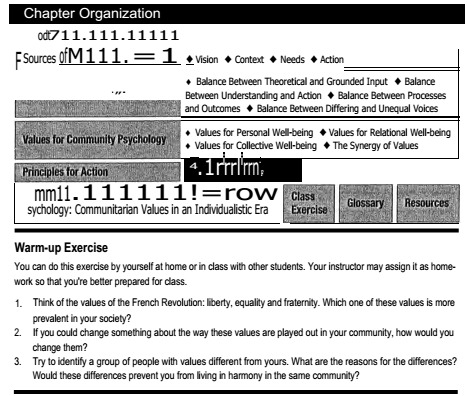
Referat Buku: Psikologi masyarakat Menghubungkan Individu dan Komunitas EDISI KETIGA Geoffrey Nelson dan Isaac Prilleltensky Bagian II Nilai, Prinsip dan Konseptual Alat Tujuan dari bagian kedua dari buku ini adalah untuk menjawab pertanyaan: Mengapa CP ingin mempromosikan pembebasan dan kesejahteraan dan prinsip-prinsip apa dan alat-alat konseptual harus mengarahkan pekerjaan CP? Dalam masing-masing empat bab dalam bagian ini, kita menguraikan prinsip-prinsip kunci dan alat-alat konseptual dan menunjukkan bagaimana mereka dapat menangani masalah-masalah sosial yang penting dan masalah.